
Please note this is a prototype webpage report that is currently under construction and based on the most recently published RPI data.
Jersey Retail Prices Index
up 2.7%
in the 12 months to March 2026
 Tier 1 Statistics

This report contains Tier 1 Statistics, as designated under the Statistics and Census (Jersey) Law 2018.
Tier 1 Statistics are those identified as essential for decision-making in Jersey, meeting the highest standards of quality, integrity, and continuity. For more information about Tier 1 Statistics and the criteria they meet, visit Tier 1 statistics.
Main points
- In the year to March 2026, Jersey’s rate of inflation slowed slightly. The Retail Prices Index (RPI) rose by 2.7%, down from 2.8% in December 2025.
- This quarter the Jersey RPI was 0.7 pp lower than the broadly equivalent UK index, the CPIH which rose by 3.4% in the same period (where ‘pp’ means percentage points — the difference between two percentage rates).
- Several groups provided an upward contribution to the annual rate of inflation, most notably alcoholic drinks, food, household services, and leisure services.
- The food group increased by 3.7%, contributing +0.4 pp to the overall rate of inflation.
- The heating oil and other fuels and petrol and oil sections increased annually by 31.9% and 3.0%, respectively.
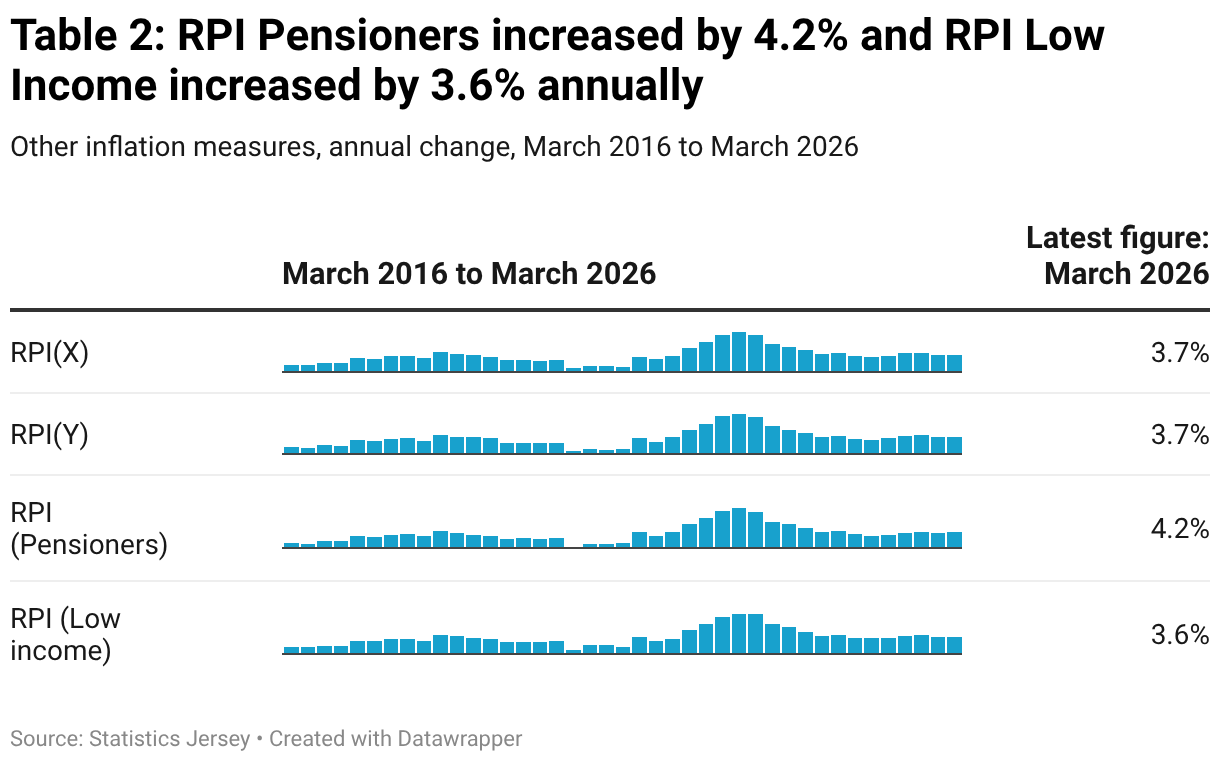
In respect of other inflation measures:
- RPI(X) increased by 3.7%.
- RPI(Y) increased by 3.7%.
- RPI (Pensioners) increased by 4.2%.
- RPI (Low income) increased by 3.6%.
Download this report as a PDF:
Things you need to know
The RPI price collection process for this March report started on 27 February and finished on 15 March 2026. This period coincided with the ongoing military action related to the Iran conflict, which began on 28 February. This conflict has resulted in a number of economic impacts, including observed changes in the price of energy products such as heating oil and petrol. However, the timing of the RPI price collection has meant that only some of these impacts will be reflected in this quarter
Changes in inflation
The Jersey Retail Prices Index (RPI) rose by 2.7% in the 12 months to March 2026, down from 2.8% in the 12 months to December 2025. This is 0.7 pp lower than the broadly equivalent UK index, the CPIH which rose by 3.4% in the same period (where ‘pp’ means percentage points — the difference between two percentage rates).


The majority of the RPI groups contributed to the lowering of the overall rate with the most significant downward contributors being:
- Motoring (-0.10pp)
- Fares and other travel (-0.10pp) and
- Leisure services (-0.07pp)
These were partially offset by upward contributions to the rate by
- Alcoholic drinks (0.20pp) and
- Household goods (0.18pp)
As illustrated in the figure below, these all contributed to the annual inflation rate for RPI lowering from 2.8% in December 2025 to 2.7% in March 2026.

Changes in prices
Most groups in the RPI saw prices increase over the 12 months to March 2026. Notable changes included:
- prices in the alcoholic drinks group increased by 8.6% on average
- prices in the tobacco group increased by 7.0% on average
- prices in the fuel and light group increased by 7.0% on average

Notable movements in prices
Fuel and oil sections
The March RPI collection process coincided with the ongoing military action related to the Iran conflict, which began on 28 February. This conflict has resulted in a number of economic impacts, including observed changes in the price of energy products such as heating oil and petrol.
The petrol and oil section includes petrol, diesel, and motor oil; this section is in the motoring group. The
heating oil and other fuels section is in the fuel and light group.
In March, heating oil and other fuels increased annually by 31.9% and petrol and oil increased by 3.0%.

RPI price collection for this report started on 27 February and finished on 15 March 2026. Changes in prices observed since this period will not have impacted this quarter’s RPI figures. Other local sources of price data, including Prices.je have recorded further price increases in these commodities after this period.
Housing group
The costs associated with housing form the largest weight in the RPI basket of goods. In March 2026, on average, the housing group decreased by 0.5% on an annual basis.
This group includes the costs of public and private sector rents, as well as the costs of mortgage interest payments. It also includes things such as parish rates and costs associated with maintaining and repairing a home.
In respect of mortgage interest payments, the Jersey RPI measures this using the Standard Variable rates published by mortgage lenders. It is therefore directly influenced by the Bank of England’s Bank Rate. See our Retail Prices Index methodology document for more details.
During the last three months the Bank of England base rate was lowered from 4% to 3.75%, and this has driven the reduction in the housing group of the RPI. The figure below shows the housing group together with the overall RPI plotted against base rate.

As can be seen, this group and the overall RPI are heavily influenced by changes in the base rate.
Within this group, notable section changes over the last 12-months included:
- Rents increased by 2.5%
- Mortgage interest costs decreased by 9.4%
The RPI(X), an alternative inflation measure that excludes mortgage interest payments, increased 3.7% over the last 12 months, compared to 2.7% for the headline RPI measure.
Food group
Changes in food prices are often of particular interest to the public and play an important role in understanding cost-of-living pressures.
Over time, the Food group has largely tracked the overall RPI. Recently, however, food prices have risen slightly faster than overall inflation. In the year to March 2025, the food group increased by 3.7%, which was:
- 1.0 pp higher than the overall RPI increase of 2.7%
- essentially unchanged compared with the previous quarter

Within the food group there were notable differences between sections, with the three largest annual increases being for:
- Beef, 19.7%
- Coffee and cocoa, 15.9%
- Lamb, 10.8%
Conversely the largest annual decreases were for:
- Cereals, -3.0%
- Tea, -4.7%
Beef had the largest five-yearly change, increasing by 60.8% followed by lamb (52.7%).
Contribution of prices to inflation
The basket of goods and services for the All Item RPI is based upon the spending of households in Jersey. Spending of Jersey households is collected as part of the Living Costs and Household Income survey.
This provides average spends by Jersey Households, which are then used to weight the impact of price changes on an average households expenditure. The largest weighting in the current basket of goods is for housing, which consists of items such as rents and mortgage interest payments.

The changes in prices when weighted result in the overall RPI rate.
In the 12 months to March 2026, the largest contributions to the overall RPI rate of 2.7% were:
- Leisure services, contributing 0.5pp
- Food, Household services, and Motoring, each contributing 0.4pp
These were partially offset by downward contributions from Housing and Household goods (each contributing -0.1pp).

Other inflation measures
As well as the headline RPI index, Jersey produces a number of additional inflation measures:
- RPI(X) – excludes mortgage interest payments
- RPI(Y) – excludes mortgage interest payments and indirect taxes
- RPI(Pensioners) – weights are based on the spending patterns of pensioner households
- RPI(Low Income) – weights are based on the spending patterns of households in the lowest fifth of household income
The table below lists the annual change for these indices:
Data sources and methods
Please see our Retail Prices Index methodology document for detailed information on how the Jersey RPI is produced.
Comprehensive information on household spending (from the Living costs and household income survey) is combined with prices of around 2,500 goods and services, which are collected every 3 months from 300 retailers, including online.
The prices are matched to the prices collected in the previous quarter, and the individual price changes are combined together to give a single overall increase. The contribution of each price change to the overall increase depends on how much the average household spends on each item.
Data Tables
You can find all data tables related to the Jersey RPI on our open data website.